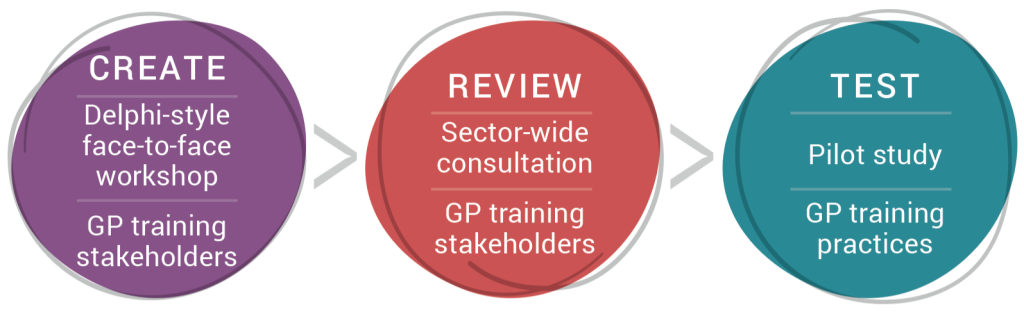
In 2019, GPSA led the development of a consensus-based framework for the GP Clinical Learning Environment (GPCLE) setting out six elements describing excellence in the clinical learning environment.
Through co-design and consensus-building with GP training stakeholders, and supported by a competitive RACGP Education Research Grant, GPSA translated the GPCLE framework into an evidence-based quality improvement GPCLE tool (read our Project Report here).
Translating the GPCLE framework into the GPCLE tool
The GPCLE quality improvement tool
The tool provides the GP training sector with an evidence-based means by which to showcase the quality of the clinical learning environment in GP training practices and identify areas for improvement.
GPSA is working with our partners and industry stakeholders – both national and international –to translate the GPCLE tool into practice and policy along the GP training pipeline.
Recent Project – Reciprocal Vulnerability
The aim of this project is to explore how self-disclosures and concealments about professional and personal matters influence the GP supervisor-registrar relationship.
The supervisor-registrar relationship is the foundation for successful training in general practice, which is underpinned by mutual trust and respect. Mutual willingness to disclose areas of professional or personal uncertainty can deepen the supervisor-trainee relationship and foster learning opportunities.
Findings from this project have been presented at key industry conferences (e.g., Reveal or conceal? and Brave enough?)
Findings and practical implications will be disseminated via a GPSA webinar and manuscript in 2025.

According to GPSA’s national survey of its members, GP supervisors who feel well-supported in their workplace, avoid working when unwell, and practise self-care have lower levels of burnout and are more likely to remain in GP training for the next 5 years.
GPSA surveyed GP supervisors in March-April 2022 and found that over 70% of GP supervisors had high levels of burnout, which was associated with lower levels of engagement in selfcare activities (including professional support, professional development, life balance, cognitive awareness, and daily balance). Younger GP supervisors were at greater risk of burnout.
Working while unwell and the belief that selfcare/wellbeing could be better supported in the workplace predicted high levels of burnout. In contrast, GP supervisors who intended to supervise for the next 5 years and were engaged in professional development were much less likely to experience burnout.

Led by GPSA in collaboration with Monash University and the Victorian Rural Generalist Program(VRGP), this rapid study aimed to explore and expand on existing evidence about rural supervision to meet the learning needs of the RG2 group across the VRGP curriculum. It specifically focused on three rural regions of Victoria: Hume, Loddon Mallee, and Barwon South West. The data obtained through surveys and one-on-one interviews with dozens of participants from primary and acute healthcare, and individuals with valuable experience in remote supervision, was used to develop a Supervision Roadmap to guide the implementation of high-quality supervised learning across the core generalist curriculum in regional Victoria.

Click here to download the extensive report for this project, which has since been cited in several Commonwealth policy documents.
Corresponding publications:
O’Sullivan BG, Martin P, Taylor CJ, Lodding M, Bilardi G, Dix L, Phillips J, Hutchinson M, Van Wollingen R, Wallace G. Developing supervision capacity for training rural generalist doctors in small towns in Victoria. Rural and Remote Health 2022; 22: 7124. https://doi.org/10.22605/RRH7124
Martin, P., O’Sullivan, B., Taylor, C. et al. Blended supervision models for post-graduate rural generalist medical training in Australia: an interview study. BMC Med Educ 22, 478 (2022). https://doi.org/10.1186/s12909-022-03529-x
GPSA has develeoped the GPCLE as a framework to guide continuous quality improvement of the practice learning environment. The GPCLE has been adapted for general practice training environments from the Best Practice Clinical Learning Environment (BPCLE) Framework as part of a research project funded by the Australian Government via the Australian General Practice Training (AGPT) Program.
Corresponding publication:
O’Sullivan B, Hickson H, Kippen R, Cohen D, Cohen P, Wallace G. A Framework to Guide the Implementation of Best Practice Clinical Learning Environments in Community General Practice: Australia. Int J Environ Res Public Health. 2021 Feb 4;18(4):1482. doi: 10.3390/ijerph18041482. PMID: 33557408; PMCID: PMC7914810.
When GPSA undertook this study in 2019-20, we interviewed 22 peer-recognised GP Supervisors and identified 7 key areas associated with quality supervision. These included reflecting and learning from other supervisors, structuring learning, caring relationships, involving the whole practice, learner centred approaches, building independence and encouraging reflection.
Corresponding publication:
O’Sullivan, B., Hickson, H., Kippen, R. et al. Exploring attributes of high-quality clinical supervision in general practice through interviews with peer-recognised GP supervisors. BMC Med Educ 21, 441 (2021). https://doi.org/10.1186/s12909-021-02882-7

Women outnumber men in Australia general practice, but are under-represented in leadership roles, such as GP supervision. You told us about the barriers to women becoming GP supervisors, and we listened (one page summary and published paper). GPSA is working with women GPs to co-design programs that address the needs, priorities, and solutions to support women in GP supervision now and into the future.
This multi-modal suite of resources will support women GPs to develop their identity and confidence as supervisors through understanding of the processes, pathways, and responsibilities involved in GP supervision, through the lens of women’s lived experiences. The program will comprise interactive webinars, information and ‘cheat’ sheets, and video vignettes about GP supervision, enabling women GPs to access information where and when they need it most
| Information Sheet | View |
|---|---|
| Pathway to becoming a RACGP AGPT GP/RG supervisor (on-site | View |
| GP/RG supervision: The benefits | View |
| GP/RG supervision: Roles and responsibilities | View |
| GP/RG supervision: Understanding payments and professional development | View |
| The supervision team: A team-based approach to general practice supervision | View |
This dedicated Community of Practice will offer a safe space for women GP supervisors to come together in an online supportive network to explore their GP supervision experiences. Small groups of novice, experienced, and expert women GP supervisors will meet monthly to discuss issues of importance to them, such as managing difficult conversations with registrars, maintaining work-life balance, self-care, technical knowledge and skills, and troubleshooting GP supervision.
These novel resources and programs were developed as the first phase of a two-year RACGP Education Research Grant. GPSA is collaborating with women GPs to develop the resources and programs, which will be trialed in the first half of 2025.
Click here to find out more
How can conflict in registrar placements be managed or (at the very least) minimised? A joint research project between GPSA, GPRA and Monash University gathered experiences of the sources and context of conflict in the GP registrar–supervisor-practice manager relationship, seeking to uncover ways to resolve or prevent escalation.
This research was conducted via on online survey and both one-to-one and small-group interviews with GP supervisors and practice managers as well as GP registrars. For more information, please email our Director of Research, A/Prof Samia Toukhsati at research@gpsa.org.au.
Best practice resources in development as an extension of this study include a guide to proactively address conflict in placements, and a number of tools for use by all members of the practice team.
This study was approved by the Monash University Human Research Ethics Committee (project number 28176).
This theoretical model was presented at the 27th Prevocational Medical Education Forum of Australia and New Zealand in November 2023.

GPEx, in association with the University of Adelaide and GPSA, recently completed a study on the financial costs and revenue associated with teaching and supervision in Australian general practices. Experienced GP Supervisors and practice managers were asked to complete a short online questionnaire to describe the teaching and administrative activities associated with teaching GP registrars in a practice and the time spent on such activities to determine the cost of these activities. We hope that the results from this research will inform future policy and practice.
This research study was approved by the University of Adelaide Human Research Ethics Committee (HREC-2021-016).
In 2021, GPSA completed a narrative analysis research project interviewing female GP supervisors about the barriers and enablers to women supervising the increasing proportion of female registrars in general practice.
This research was conducted in partnership with Monash University, EV GP Training, and Melbourne University.The research findings present significant issues that intersect to potentially impact the interest and capacity for women to join and be retained in the GP supervision workforce. The findings can be applied to developing more specific resources, supports, and structures to enable women to participate in and sustain GP supervision at the level that they find acceptable and rewarding.

Ahead of the Transition to College-led training, the 2021 GP Supervisors Australia (GPSA) Annual Survey revealed that 70% of GP supervisor respondents were satisfied or very satisfied with their Regional Training Organisation (RTO).
Click here to download the ful report.
The wellbeing and satisfaction of our supervision community is among GPSA’s highest priorities. As such, we’ve been monitoring burnout and selfcare in the GP/RG supervision community for the past three years. In 2022, we found that over 70% of supervisors had high levels of burnout, which was associated with lower levels of selfcare (see the 2022 National supervision survey report). In 2023, we delved deeper to understand the connection between wellbeing and satisfaction. Although burnout remained high, GPs who believed in the positive impact of their work in the community were less susceptible to burnout (see the 2023 National supervision survey report). Recently, in 2024, we replicated these findings and found that workplace support for selfcare, personal selfcare practices, and belief in the prosocial value of one’s work, protected against burnout (see the 2024 National supervision survey report). These findings have important policy implications to ensure that the values that attract medical doctors to general practice and GP supervision are satisfied and supported.
For GPs living in rural and remote communities, getting access to a GP, let alone one that doesn’t know you personally, can be a significant barrier to proactively engaging with the health system. To address this unmet need, GPSA is partnering with several key organisations to evaluate programs designed to support GP health and wellbeing.
Planning is well underway to evaluate the effects of a GP health outreach program – which offers face-to-face access to primary care for GPs in rural and remote locations – on lifestyle, mental and physical health, and safe work practices.
Our research shows that when GP supervisors believe that their work has value (i.e., providing a sense of meaning and purpose), they are less likely to experience burnout. Similar findings connecting value fulfilment to reduced risk of burnout were recently reported in a large Australia sample of Australian GPs (Prentice et al., 2023). This evidence-based project is evaluating the impact of Dr Shaun Prentice and A/Prof Jillian Benson’s ‘wellbeing workshops’, on GPs’ connection with their values and psychological wellbeing. This study was approved by the Monash University Human Research Ethics Committee (project number #44888) and is registered with the ANZCTR (ACTRN12624001197527p)
A report of findings will be available in 2025.
GP registrars require access to mental health and well-being support throughout their training. Practice staff including supervisors may be well positioned to provide this; however, there is limited clarity about how well-being is interpreted for registrars and training practice staff as well as responsibilities and resources required for effective implementation.
In this project, GPSA explored the perspectives of general practice managers, supervisors and GP registrars about their perception of well-being support in GP training and how it can optimally be provided to meet the needs of registrars.
This study was approved by the Monash University Human Research Ethics Committee (project number 35523).
Having examined the experiences of the GP training sector, as providers and recipients of wellbeing support, and analysed this data, GPSA ran a workshop at the GP Medical Education conference to identify strategies for improving guidance regarding the scope and responsibilities associated with this role (read about our findings here.)
Findings thus far were presented as a poster at the WONCA World Family Medicine Conference in October 2023.

According to GPSA’s national survey of its members, GP supervisors who feel well-supported in their workplace, avoid working when unwell, and practise self-care have lower levels of burnout and are more likely to remain in GP training for the next 5 years.
GPSA surveyed GP supervisors in March-April 2022 and found that over 70% of GP supervisors had high levels of burnout, which was associated with lower levels of engagement in selfcare activities (including professional support, professional development, life balance, cognitive awareness, and daily balance). Younger GP supervisors were at greater risk of burnout.
Working while unwell and the belief that selfcare/wellbeing could be better supported in the workplace predicted high levels of burnout. In contrast, GP supervisors who intended to supervise for the next 5 years and were engaged in professional development were much less likely to experience burnout.
Date reviewed: 18 June 2026