Resources
Consultation Skills Toolbox
The GPSA Consultation Skills Toolbox is a repository of useful references and resources for GP supervisors, external clinical teaching visitors and medical educators.
The toolbox is divided into the following sections:
- The consultation
- Consultation models
- Consultation skills
- Challenging consultations.
The primary resources in this toolbox are the GPSA consultation skills teaching plans. References and other resources referred to in the teaching plans are not duplicated in the toolbox.
Two practical resources we recommend reading are the 2014 AFP article Consultation skill tips for new GP registrars and its 2024 companion article Consultation skill tips for new GP registrars – an update.
It is recognised that International Medical Graduates (IMGs) may have specific teaching and learning needs. For specific tools and resources for IMGs, visit the Supervising International Medical Graduates (IMGs) webpage.
For a broad overview of the teaching consultations skills, have a look at this webinar recording.
OVERVIEW
At the heart of general practice is the consultation, the means by which GPs deliver best practice care. In its simplest form, the consultation is the sharing of information between patient and doctor, to develop both a common understanding and a plan of management.
Consultation skills encompass communication skills, but also skills such as relationship building, identifying agendas, shared decision-making, time management and follow-up. Development of consultation skills is a fundamental element of Australian general practice training.
2014 AFP paper Consultation skill tips for new GP registrars
COMMON CONSULTING PITFALLS
Understanding common pitfalls in the consultation can be very useful to guide teaching and learning.
In this video, Dr Andy Morgan discusses common pitfalls in consultations.
There have been a number of formal models of the consultation described in the international literature. Consultation models can be used as a framework to teach registrars about the importance of a structured, patient-centred and safe consultation.
RESOURCES
- In this video, Dr Simon Hay gives an overview of some of the key models for the GP consultation and some practical advice on assessing the registrar undertaking a consultation.
- Consultation models book chapter
- 2013 InnovAiT article What are consultation models for?
NEIGHBOUR'S THE INNER CONSULTATION MODEL
Neighbour’s model proposed that the general practice consultation is ‘a journey, not a destination’, and described five ‘checkpoints’ along the way.
- Connecting: Have we got rapport
- Summarising: Do I know why the patient that has come today?
- Handing over: – Have we agreed on a management plan?
- Safety netting: – Have I covered the ‘what ifs’?
- Housekeeping: – Am I in good shape for the next patient?
CALGARY CAMBRIDGE MODEL
The Calgary Cambridge Model incorporates the physical, psychological and social aspects of the consultation. In addition to its five stages, there are two ‘threads’ that run throughout the consultation.
RON ROTH MODEL
Ron Roth, a GP supervisor from Victoria, has developed his own model as discussed in this recent journal article published in the AJGP (2022): A new framework for teaching the art of general practice consultation to registrars and supervised doctors.
He presents his model in this GPSA webinar.
STRUCTURING THE CONSULTATION
Registrars often struggle to facilitate an effective, organised, and time-efficient consultation with their patients.
Resources
CONNECTING AND BUILDING THE DOCTOR-PATIENT RELATIONSHIP
A critical first step in the consultation is to connect with the patient and establish a relationship. This includes building rapport and limiting use of the computer.
Resources
COMMUNICATING EFFECTIVELY
Effective communication is an essential skill in general practice consultations. There is strong evidence linking good communication with improved outcomes for both patients and doctors.
The ‘art of communication’ has been described as applying the most appropriate skills to suit each unique patient-doctor interaction.
Resources
GATHERING DATA
Gathering data comprises the skills of effective history taking and physical examination.
Resources
- Initiating a consultation: Examples, Exercises
- GPSA teaching plan: History taking
- 2003 Arch Int Med. Building a history rather than taking one
- Using open-ended questions
- GPSA teaching plan: Physical examination
- Gathering information
BEING EVIDENCE BASED
In this video Dr Skye Boughen discusses how to teach evidence based medicine to your registrar.
IDENTIFYING AND ADDRESSING THE PATIENT AGENDA
MANAGING UNCERTAINTY
Undifferentiated presentations are very common in general practice and establishing a pathological diagnosis is often not a realistic goal. Management of uncertainty of both diagnosis and management is an essential skill for general practitioners.
Resources
In this video Dr Gerard Ingham discusses a simple ‘3R’ approach to managing uncertainty.
In this video, Simon Morgan and Justin Coleman discuss some practical strategies to support registrars to better manage anxiety.
Further reading:
PROVIDING PATIENT-CENTRED CARE
Patient-centred care can be regarded as where ‘the provider tries to enter the patient’s world to see illness through the patient’s eyes’. Common elements of patient-centred care include informing and involving patients; eliciting and respecting patient preferences; engaging patients and sharing decisions in management planning; and continuity of care.
Resources
- GPSA teaching plan: Patient-centred care
- Identifying the patient agenda using ideas, concerns, and expectations – video
PROVIDING CULTURALLY SAFE CARE
Cultural competence is defined as ‘the development of awareness and respect for differences in social structure and culture, and acknowledgement of the impacts of these on health and wellness beliefs and ability to engage with health services’. Cultural competence is a core aspect of safe general practice.
Resources
In this video, Karen Nicholls discusses an approach to providing culturally safe care to Aboriginal and Torres Strait Islander patients.
Further reading:
Aboriginal and Torres Strait Islander health teaching plans
Aboriginal and Torres Strait Islander health guide
2008 AFP. ‘Patient-centred care – cultural safety in Indigenous health’
CLINICAL REASONING
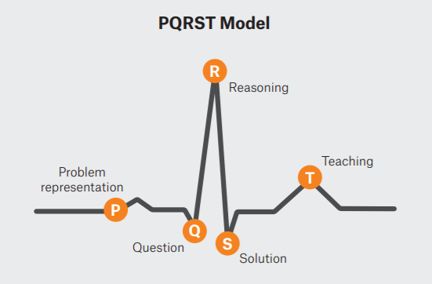
Clinical reasoning has been defined as ‘the sum of thinking and decision-making processes associated with practice … it enables practitioners to take … the best judged action in a specific context.’ It is a core element of high-quality general practice. Clinical reasoning encompasses skills in effective data gathering (history, examination and investigation); data synthesis and interpretation; communication; managing uncertainty; patient-centred care, and evidence-based medicine.
In this video, Simon Morgan explores clinical reasoning in the general practice training setting.
Resources
COMMUNICATING RISK
Risk communication is an essential part of shared decision making and evidence-based patient choice.
Resources
- In this brief video, Dr Simon Morgan gives some tips about teaching risk communication.
- Communicating risk to patients and the public. Br J Gen Pract. 2012 Apr;62(597):213-6.
BEING PROFESSIONAL AND ETHICAL
Medical professionalism is regarded as one of the core factors in providing high-quality patient care. Professionalism is closely associated with improvements in doctor-patient relationships, patient satisfaction, and healthcare outcomes.
Resources
In this video, Justin Coleman and Simon Morgan discuss teaching and learning professional and ethical practice in general practice.
Further reading:
PROVIDING PREVENTIVE HEALTH CARE
Preventive healthcare is a core aspect of many consultations. It includes the prevention of illness, screening activities for the early detection of specific disease, and the promotion and maintenance of health. Preventive health is particularly important in addressing the health disparities faced by disadvantaged population groups, like Aboriginal and Torres Strait Islander people.
Resource
MOTIVATIONAL INTERVIEWING
Effective health education involves the provision of accurate, timely, evidence-based, quality health information to patients, taking into account sociocultural factors and their level of health literacy. Two core skills for effective delivery of health education are brief intervention and motivational interviewing.
Resources
- GPSA teaching plan Brief Intervention and Motivational Interviewing
- GPSA Webinar Part 1 Behaviour change approaches for smoking cessation in general practice and motivational interviewing
- GPSA Webinar Part 2 Behaviour change approaches for smoking cessation in general practice and motivational interviewing
COUNSELLING
Counselling is a common element of the general practice consultation.
Resource
RATIONAL TEST ORDERING
Non-rational testing, and/or over-testing, is increasingly recognised as an important issue in health care. Rational use of investigations is one of the core skills of Australian general practice training and previous research has demonstrated that this is a challenging area for GP registrars.
Resource
RATIONAL PRESCRIBING
Rational prescribing is ‘the judicious, appropriate, safe and efficacious use of medicines’, and is known to be a challenging area for GP registrars.
Resources
SHARED DECISION MAKING
MANAGEMENT PLANNING
Management planning is a core aspect of the effective and safe consultation.
Resources
CHECKING UNDERSTANDING
FOLLOW-UP AND SAFETY NETTING
The basis of effective continuity of care in general practice is appropriate patient follow up. Safety netting is a key element of follow-up to ensure patient safety and help manage uncertainty.
Resources
DOCUMENTATION
Maintaining good quality medical records is a core aspect of good quality practice.
Resources
RECOGNISING LIMITATIONS
Recognising one’s limitations and appropriate help-seeking is a core general practice skill, and a fundamental aspect of safe practice and effective learning.
Resource
In this video, Gerard Ingham discusses the call for help list.
Further reading:
2020 AJGP. A ‘call for help’ list for Australian general practice registrars
MANAGING TIME
Time management in the general practice environment is particularly challenging, where every clinical assessment is required to be sufficiently comprehensive in scope to manage the presenting issues and exclude potentially serious causes, but also time efficient in order to meet patient demand. Time management is a core consulting skill but one that can take some time to develop.
Resource
- GPSA teaching plan: Time management
- In this video Dr Andrew Knight and Dr Tony Lembke talk about tips to become a time lord
BREAKING BAD NEWS
Resources
- Breaking Bad News (R3B.3)
- Breaking bad news case studies, Case 1 (R3B.4) and Case 2 (R3B.5)
- Breaking bad news scenario video using the SPIKES strategy
ADOLESCENT HEALTH
ALCOHOL AND OTHER DRUGS
MENTAL HEALTH
SEXUAL HEALTH
SAYING NO
ANGRY PATIENT
INTIMATE PARTNER VIOLENCE
END OF LIFE CARE
‘HEARTSINK’ PATIENTS
TELEHEALTH
Telehealth, using either phone or video technology, has increased significantly over recent years as a result of the COVID-19 pandemic. Telehealth consultations can be particularly challenging for IMG doctors as they require high level oral language skills to compensate for unavailability of non-verbal clues.
Resources
In this video, Simon Morgan discusses how to assess the registrar undertaking a telehealth consultation.
Further reading:
RACGP Guide to providing telephone and video consultations in general practice
GENERAL TEACHING TIPS AND RESOURCES
Resources
- Difficult doctor-patient relationships – describes methods for managing difficult relationships that involves acknowledging the problem, setting boundaries, using additional communication skills, and bringing in extra resources
- Avant article Difficult doctor-patient relationships
- Webinar Helping Your Registrar Manage Challenging Patients – Part 1, Part 2

Date reviewed: 17 July 2026
Please note that while reasonable care is taken to provide accurate information at the time of creation, we frequently update content and links as needed. If you identify any inconsistencies or broken links, please let us know by email.
 (this shuffles the deck to ensure the cards are randomly selected)