
Consultation Skills

FAQ: Minimising diagnostic error – strategies to support your registrar

What is the “trifecta” of skills?

The “trifecta” refers to the interconnectedness of clinical reasoning, the management of uncertainty, and the reduction of diagnostic error. Good reasoning and effective management of uncertainty lead to fewer errors.

Will the discussion cover how to manage errors after they occur?

No, the discussion will not focus on the management of errors after they have occurred. However, it will emphasise the importance of open discussions about errors as learning opportunities and point to resources like Medical Defence Organisation Fact Sheets.

What is diagnostic error?

Diagnostic error involves both failing to establish an accurate and timely diagnosis and failing to communicate that explanation effectively to the patient.

How common is diagnostic error in medical practice?

Diagnostic error is a significant issue, accounting for a substantial portion (around a third) of medical claims.

How can case studies be used in teaching registrars?

Case studies provide practical examples for registrars to analyse clinical reasoning, identify potential errors, and discuss strategies for improvement.

 Supervisors can:

  • Facilitate discussions about clinical reasoning and diagnostic error.
  • Use case studies to analyse decision-making.
  • Encourage reflection on clinical encounters.
  • Provide feedback on performance.
  • Create a safe environment for discussing errors and uncertainty.

The main categories are:

  • Presentation factors (how the illness presents)
  • Undifferentiated illness (early, vague symptoms)
  • Atypical presentations of common diseases
  • Rare conditions
  • Patient factors
  • Difficulty communicating
  • Complex medical histories
  • Non-compliance with investigations or treatment
  • Self-labeling or misattributing symptoms
  • Inadequate follow-up.
  • Patient delays in seeking further care.
  • Doctor factors
  • Lack of knowledge or experience
  • Cognitive biases (e.g., confirmation bias, overconfidence bias)
  • Communication barriers
  • Time pressure and fatigue
  • “HALT” factors (Hungry, Angry, Late, Tired) System factors
  • Issues with appointment scheduling and access
  • Inadequate record-keeping systems
  • Lack of follow-up and recall systems
  • Walk-in or urgent care settings that disrupt continuity of care
  • No, diagnostic errors often result from a combination of factors. The “Swiss cheese model” illustrates how multiple factors can align to create an opportunity for error.

    Cognitive biases are flawed thinking patterns that can lead to errors in judgment and decision-making.

    • Confirmation bias: Seeking or interpreting information that confirms existing beliefs.
    • Overconfidence bias: Overestimating one’s own knowledge or abilities.
    • Availability heuristic: Overemphasizing recent or memorable cases.
    • Anchoring bias: Fixating on initial information and failing to adjust appropriately.
    • Awareness: Recognizing and acknowledging one’s own biases.
    • Metacognition: Thinking about one’s own thinking process.
    • Seeking diverse perspectives: Consulting with colleagues or considering alternative explanations.
    • Using decision support tools: Checklists, guidelines, and algorithms can help mitigate bias.

    The diagnostic pause is a brief period during the consultation where the clinician intentionally stops to reflect on the case, consider potential diagnoses, and plan the next steps.

    It allows the clinician to:

    • Organise their thoughts.
    • Identify potential biases.
    • Consider alternative diagnoses.
    • Avoid premature closure.
    • Formulate a safe and effective management plan.

    Clinicians can:

    • Take a few moments to think and make notes.
    • Use phrases like, “Let me just think about this for a moment.”
    • Explain to the patient that they are taking time to consider the case carefully.

    ICE stands for Ideas, Concerns, and Expectations. These questions help explore the patient’s perspective:

    • Ideas: What do you think might be causing your symptoms?
    • Concerns: What are you most worried about?
    • Expectations: What are you hoping we can achieve today?

    Rational test ordering involves selecting investigations that are most likely to benefit the patient while minimizing harm and unnecessary costs.

    Resources include:

    • Clinical guidelines (e.g., Therapeutic Guidelines, Health Pathways)
    • The BMJ paper on how GPs diagnose
    • The RACGP Clinical Reasoning Guide

    Gut feelings are intuitive senses of unease or concern about a patient. They can be valuable signals that warrant further investigation or attention.

    These include:
  • Thorough history and examination.
  • Appropriate use of investigations.
  • Seeking second opinions.
  • Open communication with patients.
  • Reflective practice.
  • Seeking help from colleagues or specialists.
  • Using checklists.
  • Effective communication with patients.
  • Utilising recall and reminder systems.
  • Keeping a personal notebook for tracking patients.
  • Employing safety netting techniques.
  • AI has the potential to assist with tasks like documentation and data analysis. However, there are concerns about its impact on clinical reasoning and the potential for bias. The RACGP recommends against using AI scribes for GPT1 registrars.

    Date reviewed: 25 October 2025

    Please note that while reasonable care is taken to provide accurate information at the time of creation, we frequently update content and links as needed. If you identify any inconsistencies or broken links, please let us know by email.
    This website uses cookies. Read our privacy policy.
    Consultation Skills

    FAQ: Teaching Your Registrar About Men's Health

    Let’s start with a case study

    Preventative interventions in males

    Your female registrar discusses a 50 year-old man she saw this morning for a checkup:

    • born in Vietnam
    • emigrated in 1998
    • speaks reasonable English
    • a smoker
    • obese
    • high lipids
    • BP 164/90
    •  HbA1c 6.6%
    • has always thrown his National Bowel Screen kit in the bin.

    She admits she became frustrated when much of the discussion side-tracked to whether he should get an STI check, because he said “I am married and don’t need those sorts of things”, becoming visually upset. 

    What are the possible learning points for your registrar?

    1. in terms of the consultation flow?
    2. in terms of communication?
    3. in terms of clinical value for preventive health effort?

    In terms of health value, what are the greatest risks for this patient?

    For a man aged 50, the benefit is greatest for quitting smoking (24 fewer deaths per 1000 males per decade), which is 10 times the benefit of lowering lipids in a man with metabolic syndrome and 50 times greater than from participating in regular colorectal cancer screening.*

    Benefits for women are generally lower, as their baseline risk is lower.*

    *Ewald B, Del Mar C, Hoffman T. Quantifying the benefits and harms of various preventive health activities. AJGP (2018) vol 47:12

    At what ago do you recommend PSA screening to your mal patients during a general checkup?

    • Screening is not recommended because the benefits have not been clearly shown to outweigh the harms
    • GPs have no obligation to offer PSA testing to asymptomatic men
    • If requested, after specific discussion to address the benefits and harms (from overdiagnosis and overtreatment) of prostate cancer screening, a PSA test is acceptable
    • There is no doubt Australian doctors order too many PSA screening tests.**

    ** Coleman J. Excessive PSA testing in general practice. Med J Aust 2021; 215 (5)


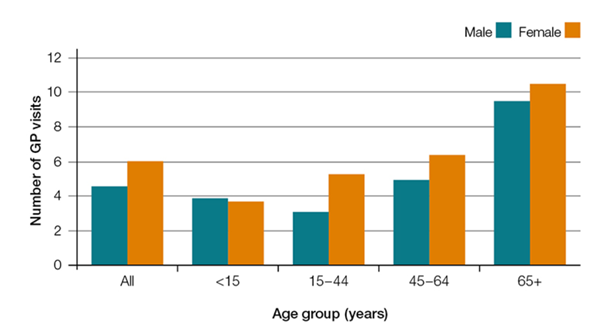
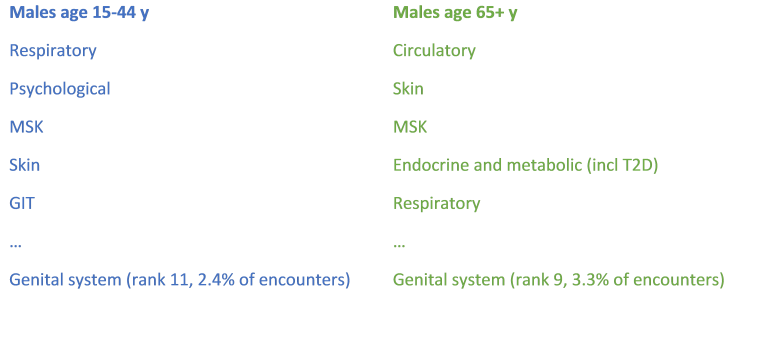
    BEACH statistics: male presentations in general practice

    Frequently Asked Questions

    • Overweight or obese; 1/4 older boys, 2/3 adult males
    • Sufficient physical activity in men ≥ 65y; 25%
    • Sufficient fruit and vegetable intake; 5%
    • 4 out of 5 heroin overdose deaths occur in males
    • 93% workplace deaths are in males (56% of the workforce)
    • Convicted for acts of violence, 90% male
    • Victims of violence, 80% male
    • Documented behavioural problems in schools, 90% male.
    • In every age group (including infancy) male deaths > female
    • In 1900, average life expectancy males 55y, female 58y
    • <14y M:F Death from accidental injury 2:1
    •  15–24y M:F MVA 3:1, suicide 3:1, all-cause 3.6:1
    • 25–65y M:F CAD 4:1, accidents 4:1, suicide 3:1, cancer 2:1, all-cause 2:1
    *** Murtagh’s General Practice, 8th edition (2022). Ch 102 Male Health
    • Ask health screening questions and discuss preventative health measures 
    • Raise sexual and mental health concerns
    • Use their language – men have a wide variety in health literacy, sometimes unexpectedly
    • Assessing the patient’s literacy goes a long way in how you engage with each person and what type of health language you use  
    It is common that those with a lower health literacy have bigger health problems (lower socio-economic)
    Yes!
    • This can increase men’s engagement in their own health and therefore their relationship with their GP 
    • Understanding the individual and what their interests are (i.e. footy team, occupation etc ) can enhance future engagement 
    • Revealing your own interests (within reason – e.g. your footy team) can also enhance a patient-doctor relationship
    • When appropriate, simplify messages and instructions:
      • Information overload can be a major problem especially with complex medical issues  
      • A simple approach can mean the difference between a patient engaging and disengaging
      • Clear-cut simplified written instructions can be helpful
    These can be summarised by the 5 A’s approach****
    1. Ask about risk factors or early signs of major health problems.
    2. Assess the level of risk and diagnose as early as possible.
    3. Advise and motivate patients to lower their risk. 
    4. Assist patients with pharmacological and non-pharmacological therapies.
    5. Arrange referral and follow-up. 

    Date reviewed: 13 November 2025

    Please note that while reasonable care is taken to provide accurate information at the time of creation, we frequently update content and links as needed. If you identify any inconsistencies or broken links, please let us know by email.
    This website uses cookies. Read our privacy policy.
    Consultation Skills

    FAQ: Assessing Your Registrar's Telehealth Consultations

    Telehealth consultations are an essential aspect of modern healthcare, and assessing your registrar’s performance in this area ensures high-quality patient care. This FAQ provides detailed guidance to help supervisors evaluate telehealth consultations effectively.

    For convenience, you can read through this resource here, or use the pdf tools at the top of the document to download and / or print the file. 

    Date reviewed: 21 October 2025

    Please note that while reasonable care is taken to provide accurate information at the time of creation, we frequently update content and links as needed. If you identify any inconsistencies or broken links, please let us know by email.

    This website uses cookies. Read our privacy policy.
    Consultation Skills

    FAQ: Managing Patients impacted by Domestic Violence

    GPSA has developed a great many resources through the unique lens of how to teach to complement the what to teach approach of training providers. Managing patients impacted by domestic violence is one topic that tests the very best and most experienced supervisor; the undisclosed life experiences of the supervisor and registrar themselves unavoidably shape the teaching and learning experience. Accordingly, rather than present a didactic solution, we have compiled here links to a number of resources including those we have developed to enable open and transparent discussions to help the registrar gain confidence in their management of patients in this context.

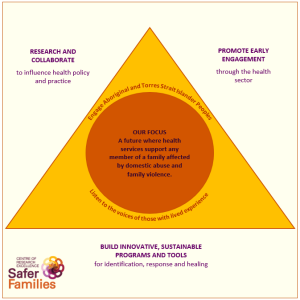
    Safer Families promotes research and education in domestic abuse and violence, as a collaboration between University of Melbourne, Murdoch Children’s Research Institute, LaTrobe University and South Australian Health and Medical Research Institute.

    AIMS
    To promote early engagement of families experiencing domestic or family violence Build innovative, sustainable programs and tools for health practitioners to identify, respond and refer for safety and healing Undertake collaborative research to transform health policy and practice responses to domestic and family violence.   Through the Readiness Program, Safer Families provides online eModules and online training workshops, including whole-of-practice training and Train the Trainer programs to support you to support others.
     

    The RACGP webinar series, in collaboration with Safer Families and Blue Knot, is a series of 90 minute webinars developed and delivered between 2021-2024. These are available live and recorded for viewing, complementing and delving deeper into chapters within the RACGP White Book.

    RACGP – Family Violence GP Education Program funded by the Victorian RACGP Faculty*

    The RACGP Victorian Family Violence Education Program Lunch and Learn series: 3rd Friday of every month from 12pm-1pm includes 1 hour of expert led de-identified case based discussion


    * Note that the RACGP provides funding both to the Victorian RACGP Faculty, and Safer Families/Blue Knot to provide education in Abuse and Violence, so these resources are designed to complement each other.  The GP Specific interest group (SIG)  bimonthly meetings focus on more practical implementation and are also an opportunity in the later part of the meetings for the workings of the SIG, including consultancy and advocacy roles.

     
    ACRRM’s Rural Doctors Family and Domestic Violence Education Package is an online Learning Module developed to strengthen the rural general practitioners’ capacity to address family violence within their community. 
    This module is based on a series of clinically focused case-based discussions with emphasis on providing best practice responses at both the individual and the community level.
    Button Example

    Date reviewed: 23 October 2025

    Please note that while reasonable care is taken to provide accurate information at the time of creation, we frequently update content and links as needed. If you identify any inconsistencies or broken links, please let us know by email.

    This website uses cookies. Read our privacy policy.
    Consultation Skills

    FAQ: Supporting GP Registrars to Manage Patient Boundaries

    For convenience, you can read through this resource here, or use the pdf tools at the top of the document to download and / or print the file. 

    Navigating patient boundaries can be challenging for GP registrars. This FAQ provides clear guidance and practical tips to support them in managing professional relationships effectively.

    Date reviewed: 17 November 2025

    Please note that while reasonable care is taken to provide accurate information at the time of creation, we frequently update content and links as needed. If you identify any inconsistencies or broken links, please let us know by email.

    This website uses cookies. Read our privacy policy.
    Consultation Skills

    FAQ: Advance Care Planning

    This FAQ provides valuable guidance on helping GP registrars develop skills in advance care planning. It offers strategies and insights to effectively teach registrars how to navigate complex discussions around end-of-life care and planning.

    For convenience, you can read through this resource here, or use the pdf tools at the top of the document to download and / or print the file.

    Date reviewed: 23 October 2025

    Please note that while reasonable care is taken to provide accurate information at the time of creation, we frequently update content and links as needed. If you identify any inconsistencies or broken links, please let us know by email.

    This website uses cookies. Read our privacy policy.
    Consultation Skills

    FAQ: Introduction to Consultation and Feedback

    Consultation and feedback are vital aspects of professional growth and patient care in general practice. This FAQ provides clear guidance on common questions to enhance your understanding and application of these essential processes.

    For convenience, you can read through this resource here, or use the pdf tools at the top of the document to download and / or print the file.

    Date reviewed: 24 October 2025

    Please note that while reasonable care is taken to provide accurate information at the time of creation, we frequently update content and links as needed. If you identify any inconsistencies or broken links, please let us know by email.

    This website uses cookies. Read our privacy policy.
    Consultation Skills

    FAQ: Managing Uncertainty

    Navigating uncertainty in medical practice is a vital skill for registrars. This FAQ provides practical strategies and expert advice to help supervisors guide their registrars in managing clinical ambiguity confidently.

    For convenience, you can read through this resource here, or use the pdf tools at the top of the document to download and / or print the file.

    Date reviewed: 21 October 2025

    Please note that while reasonable care is taken to provide accurate information at the time of creation, we frequently update content and links as needed. If you identify any inconsistencies or broken links, please let us know by email.

    This website uses cookies. Read our privacy policy.
    Consultation Skills

    FAQ: Supporting Your Registrar to Provide Best Practice Care for Nursing Home Residents

    This FAQ provides guidance on supporting registrars in delivering best practice care for nursing home residents. It covers practical strategies, key considerations, and resources for improving care in these settings.

    For convenience, you can read through this resource here, or use the pdf tools at the top of the document to download and / or print the file.

    Date reviewed: 28 October 2025

    Please note that while reasonable care is taken to provide accurate information at the time of creation, we frequently update content and links as needed. If you identify any inconsistencies or broken links, please let us know by email.

    This website uses cookies. Read our privacy policy.
    Consultation Skills

    FAQ: Observing Your Registrar

    Observing your registrar provides a valuable opportunity to enhance your skills as a GP supervisor. This FAQ offers practical insights and guidance to optimize your supervision approach.

    For convenience, you can read through this resource here, or use the pdf tools at the top of the document to download and / or print the file.

    Date reviewed: 25 October 2025

    Please note that while reasonable care is taken to provide accurate information at the time of creation, we frequently update content and links as needed. If you identify any inconsistencies or broken links, please let us know by email.

    This website uses cookies. Read our privacy policy.