Finalisation of 2022 NTCER Review

General Practice Supervision Australia (GPSA) and General Practice Registrars Australia (GPRA) are happy to announce the conclusion of the biennial 2022 Review of the National Terms and Conditions for Employment of Registrars (NTCER).

Key NTCER amendments to be implemented across the next 4 training semesters (2023.1-2024.2) include:

  • Staggered 4% increase to minimum Base Rate (full details outlined in table below);
  • Extending Educational Release support for GPT3/CGT3 registrars;
  • Amending Educational Release to provide full-time parity for part-time registrars;
  • Strengthened focus on fatigue management through increase in allocated Administration Time;
  • Revised Preamble to emphasise the minimum nature of the terms and conditions under the NTCER, above which practices and registrars are free to negotiate for mutual benefit and according to commercial viability;
  • Replacing the Restrictive Covenant with a Non-Solicitation clause.

As the peak organisations charged with administering the NTCER, GPSA and GPRA have finalised this review as it began – with collaboration, mutual respect, and a positive outlook. Both organisations recognise there is more to be done and will press ahead with advocacy for increased support and investment in the future of primary health care.

The main win for both organisations is the relationship forged through the underpinning principles GPRA and GPSA set for this review process in July 2022:

1)           Models of employment for GP registrars across Australia need to be fair and equitable, delivering working conditions and remuneration that compares with other specialist trainees while taking into account the context of training practices;

2)           General practice is a rewarding medical specialty and an attractive vocational pathway for junior and/or pre-vocational doctors;

3)           GP trainees and GP supervisors are equally desirous of and entitled to a quality training experience;

4)           GPRA and GPSA, as the recognised national peak bodies representing all GP registrars, GP supervisors and GP training practices, have a critical role in advising all levels of government on all matters of relevance to the GP training sector;

5)           Appropriate support and funding for GP supervisors and GP training practices is crucial for the sustainability of the nation’s primary health system, which in turn underpins the nation’s wider healthcare system.

As part of this process, future collaborations between GPSA and GPRA on a variety of projects have been agreed, including the co-development of:

  • A Fatigue Management Policy;
  • Employment contract templates;
  • Resources to assist practice managers overseeing the employment of GP or RG registrars;
  • FAQs for registrars and practices;
  • A shared benchmarking process to inform future biennial NTCER reviews.

Recognising the need to minimise the impact on training practices in the current climate, agreement has been reached to stage base rate and administration changes across the next 4 training semesters, leading into the next review period in Semester 2 of 2024. A summary of these changes and their timing is included below:


Implementation of Changes to NTCER by Training Semester

Educational release (clause 9.2)

Where GPT3s have mandated workshop requirements during standardly rostered hours, these will be included as paid time by practice (unless on a weekend or after
hours)


Restrictive covenant (clause 17)

Clause to be removed from NTCER and replaced with non-solicitation of patient and
staff


Parity for part-time registrars re
educational release
(clause 9.2)

Training practices to provide part-time GP trainees educational release in parity with full-time GP trainees


Redrafted “Preamble” and “About the
Agreement”

Updated to reflect staging of changes and new framework for biennial
review


3% increase to minimum base rate (per current Remuneration Schedule) on top of indexation


Administration time (clause 9.3)

Increase to scheduled 30 mins per session (half day) to max 5 hours per week

1% increase to minimum base rate on top of indexation

Next biennial review To be carried out under mutually agreed process and timeframe in 2024.2, with view to conclusion before recruitment for training placements commences (i.e. by September 2024 for 2025.1)  

The updated NTCER Agreement is available for viewing and downloading here.

Date reviewed: 24 June 2025

Please note that while reasonable care is taken to provide accurate information at the time of creation, we frequently update content and links as needed. If you identify any inconsistencies or broken links, please let us know by email.

This website uses cookies. Read our privacy policy.
Page 3

First Practice Manager to be awarded for Commitment to Excellence in GP Training

Jennifer Moss, Practice Manager, Tumby Bay Medical Clinic
Jennifer is GPSA’s first Practice Manager (PM) to receive a Recognition Award, having been nominated for going above and beyond to support GP registrars through their placements at Tumby Bay Medical Clinic.

Jennifer stepped into the demanding role of PM just as the practice increased its GP registrar and med student training positions. Quickly assessing the needs of the trainees, she was soon providing accommodation for registrars on call overnight at the local rural hospital, especially those who normally live out of town. This doesn’t just mean providing a bed, but opening up her home for company and support and family connections.

Within the practice, Jennifer is known for remembering (and making a fuss over) staff birthdays and other special occasions, creating a close-knit, supportive ‘work family’ environment. As her nominating colleague states:

These are the things that make our work such a great place to be and helps everyone in the busy-ness of day-to-day general practice work more productively for our community.”


Date reviewed: 12 November 2025

Please note that while reasonable care is taken to provide accurate information at the time of creation, we frequently update content and links as needed. If you identify any inconsistencies or broken links, please let us know by email.

This website uses cookies. Read our privacy policy.
Page 3

General Practice Clinical Learning Environment

Why structure a learning environment?

Structuring a learning environment creates consistency of practice, improves patient safety, and helps both the supervisor and registrar know what is expected of them. It enables GP supervisors to utilise the whole context to promote learning. It allows practices to plan for, establish, and regularly appraise the quality of their learning environment for improved educational outcomes.

What is the General Practice Clinical Learning Environment (GPCLE)?

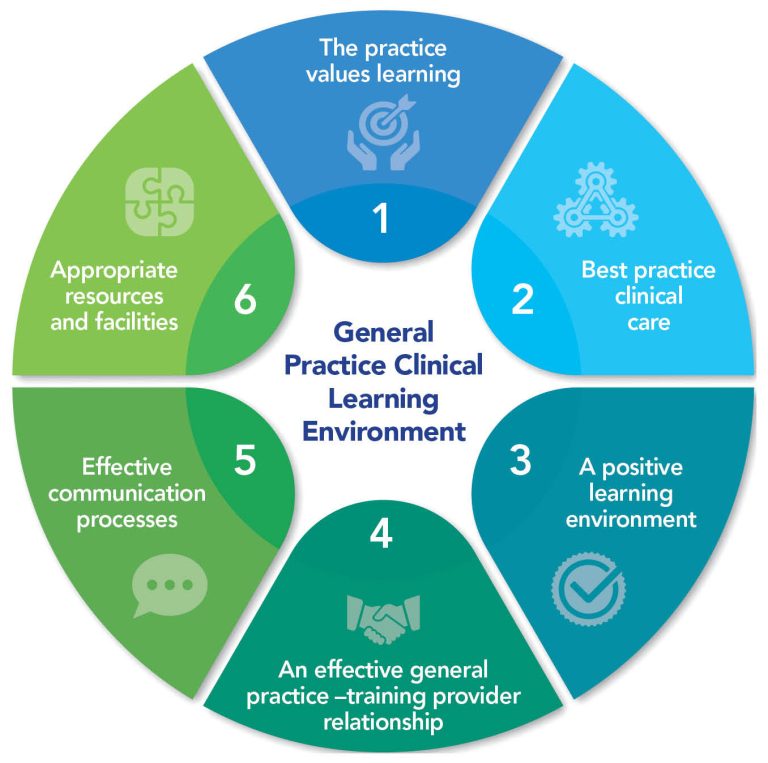
The GPCLE is a holistic and evidence-based framework to guide the development of best practice clinical learning environments in general practice. The framework is particularly applicable for new teaching practices, new supervisors and for benchmarking and planning quality improvement for existing practices.

The GPCLE framework comprises six elements, 19 objectives, and 53 descriptors of quality.

Date reviewed: 11 December 2025

Please note that while reasonable care is taken to provide accurate information at the time of creation, we frequently update content and links as needed. If you identify any inconsistencies or broken links, please let us know by email.

This website uses cookies. Read our privacy policy.

This content is password-protected. To view it, please enter the password below.

Date reviewed: 17 November 2025

Please note that while reasonable care is taken to provide accurate information at the time of creation, we frequently update content and links as needed. If you identify any inconsistencies or broken links, please let us know by email.

This website uses cookies. Read our privacy policy.
Page 3

Workplace Discrimination, Bullying and Harassment Policy

GPSA is committed to providing a safe, flexible and respectful environment for staff and stakeholders free from all forms of discrimination, bullying and sexual harassment.  Check out GPSA’s Workplace Bullying, Discrimination and Harassment Policy.

Training practices which implement zero tolerance policies for bully and harassment are happy places to work. If you need a policy for your own practice, or an updated policy read on.

Workplace discrimination, bullying and harassment policy template

This template will help you create your own workplace discrimination and harassment policy. It covers topics relevant to the following Federal laws:

Sex Discrimination Act 1984 (Cth)
Racial Discrimination Act 1975 (Cth)
Disability Discrimination Act 1992 (Cth)
Age Discrimination Act 2004 (Cth)
Australian Human Rights Commission Act 1986 (Cth).

Other Federal and state/territory laws may also apply to your workplace.

CLICK HERE to view more information and download a copy of the template.

For further information on bullying and harassment in the workplace, download a copy of GPSA’s guide Bullying and Harassment: Pursuing Zero Tolerance in General  Practice.  The guide explains how to recognise and manage this behaviour, fostering a healthy work culture which benefits staff and patient care.  Use the Guide as a tearoom, team building and induction resource to complement your other educational activities.

Date reviewed: 14 November 2025

Please note that while reasonable care is taken to provide accurate information at the time of creation, we frequently update content and links as needed. If you identify any inconsistencies or broken links, please let us know by email.

This website uses cookies. Read our privacy policy.
Page 3

Templates for Registrar Employment

Having an appropriate employment contract in place before your registrar commences in your practice is an incredibly important piece of the puzzle.

While the two are interdependent to an extent, this contract is distinct from the training agreement, serving as the document to which you and your registrar will refer if there is ever anything in question about their employment conditions.

Getting this right is not always easy. An overly-lengthy contract is rarely read in full, and a contract that’s oversimplified is liable to under-explain the two-way protections – rights and responsibilities of employer and employee – that need to be set out in an employment agreement.

GPSA has proudly supported our members since 2016 with an employment contract template developed in line with both Fair Work Australia’s National Employment Standards (NES) and the National Terms and Conditions for the Employment of Registrars (NTCER).  These templates are now separated for convenience into part-time and full-time to ensure greater clarity around key responsibilities for both parties.

GPSA’s downloadable employment templates and tools can be accessed by logging into your free GPSA Community account here and clicking on the below links:

Date reviewed: 20 November 2025

Please note that while reasonable care is taken to provide accurate information at the time of creation, we frequently update content and links as needed. If you identify any inconsistencies or broken links, please let us know by email.

This website uses cookies. Read our privacy policy.
Page 3

Medicare Provider Numbers

The Medicare provider number (MPN) application process applies to GP registrars when they join or renew placements under the Australian General Practice Training (AGPT) Program. This work now resides with the Access Policy Section in the Rural Access Branch of DOH.

Medicare has advised that the majority of delays relating to MPN applications from GP registrars are due to inconsistencies between the name used on the AGPT program placement documentation and the name used on the MPN application form. Any delays that currently apply to assessing these applications can be significantly reduced if GP registrars always fill in documentation using their name as it appears on their current registration with the Australian Health Practitioners Regulation Agency (AHPRA). This will ensure the expeditious location and processing of MPN applications when required from GP registrars.

In broad terms, there are two separate application processes that apply when a GP registrar requires Medicare access for a training practice:

  • The AGPT placement process, which satisfies 3GA 6E of the Health Insurance Act 1973 (the Act).
  • The provider number application process.

This process requires the college to submit a complete AGPT placement form to the Access Policy Section of DOH. The placements are always submitted electronically to agptmpnapplications@health.gov.au. The Access Policy Section of Health provides an auto-confirmation that the placement has been received in response to this email.

The placements are assessed within 72 hours of receipt by the Department of Human Services (DHS). In cases where the Access Policy Section cannot process the placement, the College(s) will be contacted for further information. This contact will occur within 72 hours of the Access Policy Section receiving the placement and such subsequent contact generally leads to the placement being processed.

The MPN process for GP registrars is more complicated and warrants careful consideration. It is firstly important to understand that DHS – Medicare does not always require a MPN application to be submitted when a GP registrar is granted a new placement on the AGPT program.

A MPN application must be submitted by a GP registrar when undertaking a new AGPT placement if:

The registrar is subject to section 19AB of the Act and requires a section 19AB(3) exemption from the Access Policy Section of Health for the new placement
The registrar is not subject to section 19AB but they have not held a prior AGPTP placement at the practice location.

In cases where the registrar is not subject to section 19AB, DHS – Medicare can arrange Medicare access for a new semester placement without a formal MPN application if the doctor has had a prior AGPTP placement for the practice. DHS – Medicare can arrange Medicare access without a formal application in these cases because the registrar:

Is not subject to an exclusion on their Medicare eligibility under section 19AB;


The existence of the prior AGPT placement means there is no need to establish a business relationship between the registrar and employer for the purpose of paying Medicare rebates.

In cases where the above two conditions are satisfied, DHS – Medicare can extend Medicare access once the AGPT placement process has been completed and the registrar submits a letter requesting that the extension be processed.

When the GP registrar is seeking Medicare access for the first AGPT semester, they will need to complete an Application for an initial Medicare provider number for a medical practitioner form (HW019).

When the registrar is seeking Medicare access for any subsequent AGPT semester, and it can be established from the rules set out above that an MPN application is required, they will need to complete an Application for an additional location Medicare provider number for a medical practitioner.

MPN Application forms need to be sent to:

By email:

provider.registration@humanservices.gov.au

By mail:

Medicare Australia
Provider Eligibility Section
GPO Box 9822
in your capital city

By fax:

NSW/ACT (02) 9895 3439
QLD (07) 3004 5634
VIC/NT (03) 9605 7984
SA/TAS (08) 8274 9307
WA (08) 9214 8201

In cases where the registrar requires a section 19AB exemption for Medicare access, DHS – Medicare will apply to the Access Policy Section for this as part of the MPN application process. There is no separate application form that needs to be completed by the registrar to ensure this application takes place. DHS – Medicare will be able to identify that a registrar is subject to section 19AB by the information they provide when completing the MPN.

The section 19AB assessment process occurs without contacting the applicant doctor to advise that an exemption application has been received on their behalf. The Access Policy Section does not provide this information to ensure expedient assessment of applications. The Access Policy Section will only contact an applicant registrar if additional information is required to grant the exemption. The registrar is notified in writing once the exemption is granted. DHS is advised immediately so that a provider number can be granted to the registrar.

If a registrar is seeking confirmation of an exemption application, the Access Policy Section can be contacted at 19AB@health.gov.au


Q: How will I know my application has been received?

A: Registrars can seek confirmation of receipt of their application by calling 132 150. This contact is effective where the registrar applies using their name as it appears on their AHPRA registration and their application can be found by DHS–Medicare.


Q: How long will it take to process my application?

A: It can take up to 28 days to process especially in peak periods.


Q: My application has been delayed, why?

A: DHS–Medicare has advised that the majority of delays relating to MPN applications from GP registrars are due to inconsistencies between the name used on the AGPT placement documentation and the name used on the MPN application form. Any delays that currently apply to assessing these applications can be significantly reduced if GP registrars always fill in documentation using their name as it appears on their current registration with the Australian Health Practitioners Regulation Agency (AHPRA).


Q: Is there any way to check the status of my registrar’s Medicare provider number application?

A: There is currently no way to check the status of a specific Medicare provider number application online or by phone. DHS staff can only confirm receipt of the application if the registrar who submitted the application contacts them.

Date reviewed: 14 November 2025

Please note that while reasonable care is taken to provide accurate information at the time of creation, we frequently update content and links as needed. If you identify any inconsistencies or broken links, please let us know by email.

This website uses cookies. Read our privacy policy.