
Brave enough to be vulnerable: exploring a GP Training prerequisite

For convenience, you can read through this explanatory statement here, or use the pdf tools at the top of the document to download and / or print the file. 

Findings of this GPSA-led research were presented at the WONCA worldwide family medicine conference in October 2023. 

Date reviewed: 11 November 2025

Please note that while reasonable care is taken to provide accurate information at the time of creation, we frequently update content and links as needed. If you identify any inconsistencies or broken links, please let us know by email.
This website uses cookies. Read our privacy policy.

2023 GPSA National Supervision Survey Report

For convenience, you can read through this document here, or use the pdf tools at the top of the document to download and / or print the file. 

Date reviewed: 11 November 2025

Please note that while reasonable care is taken to provide accurate information at the time of creation, we frequently update content and links as needed. If you identify any inconsistencies or broken links, please let us know by email.
This website uses cookies. Read our privacy policy.

Summary: Key Findings on Female Supervisors in General Practice

The research explores the findings of the “Women in Supervision” study, focusing on the role of female supervisors in Australian general practice and the unique challenges they face. It aims to provide insights into supporting female professionals in supervisory roles.

For convenience, you can read through this summary here, or use the pdf tools at the top of the document to download and / or print the file. 

Date reviewed: 14 November 2025

Please note that while reasonable care is taken to provide accurate information at the time of creation, we frequently update content and links as needed. If you identify any inconsistencies or broken links, please let us know by email.
This website uses cookies. Read our privacy policy.

More supervisors for teaching the next generation of rural GPs

For convenience, you can read through this resource here, or use the pdf tools at the top of the document to download and / or print the file.

Date reviewed: 11 November 2025

Please note that while reasonable care is taken to provide accurate information at the time of creation, we frequently update content and links as needed. If you identify any inconsistencies or broken links, please let us know by email.


This website uses cookies. Read our privacy policy.

Burnout? It's more common than not

At the GP22 conference in Melbourne at the end of November 2022, GPSA’s Director of Research, Dr Samia Toukhsati, presented the findings she developed with Monash University’s Dr Rebecca Kippen and GPSA’s former and current CEOs, Glen Wallace and Carla Taylor.

The aim of GPSA’s study was to explore the wellbeing and selfcare of GP supervisors in Australia.

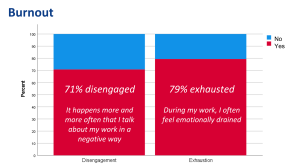
The method included use of the 16-item Oldenburg Burnout Inventory to evaluate disengagement and exhaustion through a procedure involving:

Monash Human Research Ethics Committee approval (#19442) Feb 2022
Completion of the GPSA National Supervisor Survey by GPSA members in March-April 2022
Analysis of survey data, in particular socio-demographics, GP supervision experience, access to leave, indications of burnout and selfcare


What the literature says about burnout...

Burnout is an ‘occupational phenomenon’(1)

  • Unrelenting workplace demands
  • Unmeetable goals

Burnout is common in GPs around the world(2, 3), including GP registrars(4)

  • Stressful, high pressured environments
  • High workload and long hours
  • Emotional strain(5)

Burnout occurs when one’s ‘wellbeing reservoir’ is depleted(4)


Discussion points

Burnout impacts over 70% of GP supervisors

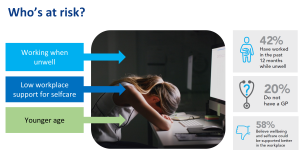
Modifiable personal risk factors include:

  • Working when unwell
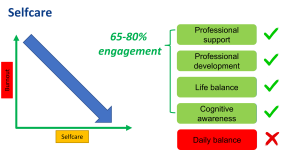
  • Selfcare (need to increase daily balance / self-awareness and mindfulness)

Benefit of increasing personal agency to set boundaries: empowerment and choice

Burnout represents a systemic workplace and workforce problem

Create resilient workplaces, not just resilient workers(6)

  • Supportive culture
  • Supportive policy
  • Supportive tools

REFORM!

Change needed at the sector level, requiring a systems and government response(7)

  • Urgent and increased government investment in general practice and workforce training
  • National guidelines and organisational policies to prevent healthcare worker burnout(7)
  • Model Work Health and Safety Regulations (as at 14 Apr 2022)(8) – 55A Psychosocial hazards; 55B Psychosocial risks; 55C-D Control measures

References

  1.  World Health Organisation. International Classification of Disease for Mortality and Morbidity Statistics (ICD), 11th revision, Geneva, 2018
  2. HIMMS and NUANCE Communications. From overload to burnout. What clinicians think. 2021. Available at www.nuance.com/content/dam/nuance/en_uk/collateral/healthcare/white-paper/wp-from-overload-to-burnoutwhat-clinicians-think.pdf
  3. Shen et al. (2022). The global prevalence of burnout among general practitioners: a systematic review and meta-analysis. Family Practice, 2022, XX, 1–8. https://doi.org/10.1093/fampra/cmab180
  4. Prentice et al. Burnout, wellbeing and how they relate: A qualitative study in general practice trainees. Med Educ. 2022; 1-13.
  5.  Zarei et al. Prevalence of Burnout among Primary Health Care Staff and Its Predictors: A Study in Iran. Int. J. Environ. Res. Public Health 2019, 16, 2249; doi:10.3390/ijerph16122249
  6. Henderson JD. Self-Care is Not the Solution for Burnout. Medium, 14th Jan 2022. Available at https://index.medium.com/self-care-is-not-the-solution-for-burnout-6969bc0a2de6
  7. Warby T. Why Australia needs a systemic response to burnout. newsGP 24 Aug 2022. Available at https://www1.racgp.org.au/newsgp/gp-opinion/why-australia-needs-a-systemic-response-to-burnout
  8. Work Health and Safety Regulations 2011. Available at https://www.safeworkaustralia.gov.au/sites/default/files/2022-06/model_whs_regulations_-_14_april_2022.pdf

THIS IS JUST ONE EXAMPLE OF THE RESEARCH GPSA UNDERTAKES IN OUR EFFORT TO DEVELOP BEST PRACTICE RESOURCES, CREATE POLICIES FOR THE IMPROVEMENT OF GP TRAINING CONDITIONS, AND ADVOCATE ON BEHALF OF OUR MEMBERS.

TO REPRESENT YOU FAITHFULLY, WE NEED TO HEAR YOUR VOICE. PLEASE CONSIDER PARTICIPATING IN OUR MEMBER SURVEYS AND RESEARCH INTERVIEWS, AND REACH OUT TO US WITH ANY ISSUES / CONCERNS / QUERIES AT SUPPORT@GPSA.ORG.AU.

Date reviewed: 11 November 2025

Please note that while reasonable care is taken to provide accurate information at the time of creation, we frequently update content and links as needed. If you identify any inconsistencies or broken links, please let us know by email.

This website uses cookies. Read our privacy policy.

Who are the first responders for GP registrar wellbeing?

Those involved in GP training often wear many different hats: among these is the nebulous role of pastoral carer to support the wellbeing of GP registrars.

By sharing your experiences as providers and recipients of wellbeing support, we can identify strategies for improving guidance regarding the scope and responsibilities associated with this role.

This study involves a 10-15 minute online questionnaire, and, if you are interested, two optional follow-up surveys at 6-month intervals. Participants are invited to enter a draw for a $500 gift voucher.

If you are interested in participating, please read the Explanatory Statement and then go to the online questionnaire.

This study has been approved by the Monash University Human Research Ethics Committee (project number 35523).

Date reviewed: 24 June 2025

Please note that while reasonable care is taken to provide accurate information at the time of creation, we frequently update content and links as needed. If you identify any inconsistencies or broken links, please let us know by email.

This website uses cookies. Read our privacy policy.

Women in GP Supervision

GPSA recognises the pivotal role played by women GP Supervisors in GP Training. Recognising that there are many barriers for Women GP Supervisors, GPSA funded a narrative research project  interviewing female GP supervisors about why women GPs supervise registrars, or choose not to. 
This page presents some of the research findings and themes discovered.

This research was conducted in partnership with Monash University School of Rural Health, EV GP Training and Melbourne University.


I don’t remember doing any specific education on how to be a supervisor. I had to figure out a lot of stuff myself or by asking other people.

Research respondant


Key research themes discovered

  • Women GPs describe having limited control over the decision to supervise registrars and were not fully informed about the role.
  • Some women GPs play a key role in the formal and informal supervision workload in practices that is not appreciated as a valued contribution.
  • Some male registrars may disrespect women GP supervisors as mentor-teachers.
  • Some women GP supervisors felt unsupported by male superiors to manage male registrars who were not receptive to their feedback.
  • Some women GPs lead the teaching and learning in their practice, but, if engaged as a non-practice owner, they may not get adequate practice support to sustain the task.
  • Some women GPs describe being unaware of and unremunerated for aspects of the supervision role.
  • Women GPs can experience unsuccessful negotiations with male practice owners around pay for the structured teaching they did.
  • Women GP practice owners and non-practice owners with lead educational roles in the practice are inclined to remunerate women GPs for structured teaching.
  • Inadequate remuneration relative to the workload can affect early-career GPs interest in doing supervision work and mature GPs from continuing it.
  • Pay is valued as part of recognition by women GP supervisors of different demographics and career stages.
  • Women GPs believe they are sought out by registrars because they are approachable and value registrar learning and wellbeing, regardless of whether supervising formally or informally; but the time needed for frequent encounters is frustrating for women GPs when they are not the main supervisor.
  • Women GPs are asked to support registrar learning across women’s health, mental health, sexual health and complex care where they are perceived as experts, and this interrupts the time they need for their own patients (sensitive consultations).
  • The time commitment for supervising is worse if registrars are junior, unsafe or under-performing.
  • When women GPs take a break from or relinquish supervision roles, they express a sense of relief at not having to worry about learners and having time to do other things, such as invest in their own learning.
  • Women GPs of various ages describe the challenge of managing personal commitments, particularly to parents and children, with committing to supervise registrars over a 6-month term.
  • Informal supervision roles allow women to accommodate other life responsibilities whilst enabling them to be involved in supervision.
  • Women planning to have children describe potential career disruptions as a barrier to supervising.
  • The capacity to juggle children can vary depending on how family-friendly the practice is, and the proximity between practice and childcare/school.
  • Overall, women GPs may view supervision as an additional effort atop of their professional and personal lives.
  • Women GPs are intrinsically motivated to provide quality teaching and learning to create a positive experience for registrars. This could deter women from supervising unless they felt able to do it in a way that met their personal standards.
  • Women GPs actively pursued ways to build their supervision expertise to enable them to supervise to a high standard. To this end, women GPs noted a lack of educational support and guidance to foster understanding of the supervision role.
  • Women GPs preferred team supervision to provide backup for registrars and opportunities to share ideas.
  • Women GPs gained confidence from teaching medical students and overseeing registrar learning in other general practices (as an independent clinical educator).
  • Women GPs seek formal and informal opportunities to exchange ideas and share resources with other GP supervisors, such as supervision mentoring.
  • Women reflect on and reconcile the level of uncertainty involved in supervision which enables them to keep supervising even when registrars don’t progress.
  • Imposter syndrome is common in women GPs commencing supervision roles.
  • Early-career women GPs think they lack sufficient technical GP knowledge to be teaching, but perceive strength in their fresh knowledge of the GP training program and are encouraged if they are in a supportive team where they can learn to supervise and their value to the team is acknowledged.
  • The historical requirement for early-career GPs to get some experience before taking up supervision roles was viewed as a barrier to new women GPs to take up supervision
  • Some mid- and later-career women GPs experience imposter syndrome if they lack knowledge of current GP exams and clinical guidelines, but they draw confidence from their expertise in real-world practice, which helps them be assertive about their value.
  • Women GPs overcome imposter syndrome and build confidence in a supervisor identity when they can bounce ideas around a team, reflect on their practice, and realise their unique contribution is based on the types of patients that they see, the way that they teach, their specialisations, and the nature of medicine that they practise.


I actually didn’t put down my name to actually be an official … supervisor. Although I was teaching, I was doing it in an unofficial manner. But my boss [practice owner] took it on himself with his wife to forge my signature to say that I was going to be prepared to be doing this teaching. One day, three registrars arrived.
Research respondant


Discussion

Women GPs interviewed in the study agree that there is a lack of recognition and remuneration for teaching, which can deter them from taking on supervision roles. This included non-practice owners being left out of business decisions related to supervision, such as recognition and payment of supervisors. Commonly, women contributed to GP supervision in informal ways without pay or recognition. The quality of women GP Supervisors was seen as high, and they were often seen as more available and approachable. There was seen to be a gendered substructure within practice supervision, where women supervise around explicit and implicit rules according to their gender and position. 

Knowledge about supervision roles and payments for supervision should be more clearly communicated to women, as well as how to get involved and supports available such as the peak body. Practice supervision policies should require consultation with women GPs for inclusion in supervision, document supervision roles and activities available for remuneration. Policies should also be extended to enable women to enter and re-enter supervision roles across their career span

For Women GP supervisors who are more often covering sensitive topics like women’s health, mental health, and sexual health, there are difficulties in caring for their own patients and managing registrar interruptions. Women GPs often expressed a lack of confidence in supervising, seeking  validation through technical or real-world medicine. 

To break through stereotypes and support women GP Supervisors, respondents felt that better acknowledgement of the valued contribution of women GP supervisors, and more woman-specific mentorship networks for supervision are needed.  Promoting team-based supervision where women GPs have a clear role and can make a quality contribution through a shared commitment will also assist in this change.


… I think [the next generation of women] … have less barriers because they’re all more assertive…than maybe my generation was, or maybe I am.

Research respondant


Conclusion

This research expands understanding of the lived experience of Australian women GP supervisors as they navigate taking up and managing supervision roles. The research points to story arcs which were about power and control, pay, time, other life commitments, quality of supervision, and supervisor identity. These represent significant issues that intersect to potentially impact the interest and capacity for women to join and be retained in the GP supervision workforce. The findings can be applied to developing more specific resources, supports, and structures to enable women to participate in and sustain GP supervision at the level that they find acceptable and rewarding.

Date reviewed: 14 November 2025

Please note that while reasonable care is taken to provide accurate information at the time of creation, we frequently update content and links as needed. If you identify any inconsistencies or broken links, please let us know by email.

This website uses cookies. Read our privacy policy.

Research - What does GP Supervision cost?

Cost of Supervision Research

GPEx, in association with the University of Adelaide and GPSA, are undertaking a study on the financial costs and revenue associated with teaching and supervision in Australian general practices [link to project clarification document on GPSA website]. First, we want to extend our thanks to the supervisors and practice managers who have been involved in this project.

We have finished interviewing supervisors and practice managers and found that often “teaching a registrar takes a village”. The substantial investment from the supervisor/s and the practice manager were evident. Practice level (eg., having experienced supervisors) and system level (eg., having a suite of resources) factors were seen to enable the teaching and supervision of registrars.

An important theme was that this is not a “one size fits all” model and there was substantial variation across practices. Practices and supervisors want to retain registrars after training and are invested in developing the future GP workforce because they love teaching. These findings informed the development of an online national survey, for which data collection has concluded. A cost revenue analysis is underway and a report of the findings will be available in 2022.

Below are some of the key findings so far:

What the practices said:

  • It’s not just the supervision and teaching
  • The practice manager invests substantial time too
  • Teaching a registrar takes a village
  • There are other financial and non-financial costs
  • It is difficult to quantify
  • It is not a one size fits all model
  • It is part of a complex bigger picture

What makes it easier….

    Practice level 

  • Patient scheduling
  • Experienced supervisors and practice
  • Flexible practice
  • Efficient medicare billings
  • Relationship with registrars

    System Level
  • Available suite of resources
  • Supervisors engaging in activities they enjoy and see the value in
  • Practice-registrar fit
  • Multiple registrars
  • Opportunity for longer placements

Why do we do it?

  • Keeping registrars after training
  • Keeping up to date
  • Intrinsic motivation to support the development to training our future GPs
  • The love of teaching

Visit the GPSA Research page for future updates on this research and it’s findings.

Date reviewed: 11 November 2025

Please note that while reasonable care is taken to provide accurate information at the time of creation, we frequently update content and links as needed. If you identify any inconsistencies or broken links, please let us know by email.

This website uses cookies. Read our privacy policy.

Research

Our Research Mission

GPSA’s research mission is to support quality GP training through the development of evidence-based resources. This work ultimately supports member wellbeing and satisfaction by building workforce capacity and resilience.

Our Research Agenda

Our research agenda is responsive to the evolving priorities of our members and the GP training sector. This enables us to pivot our focus as the environmental context changes, across key areas including:

  • Evidence-based advocacy
  • Policy development
  • Education initiatives
  • A broad range of resources

Partnerships

Alongside our members, we partner with universities, sector stakeholders, and policy makers to expand our work in the GP and RG (Rural Generalist) training space.

Our Annual National Survey

As part of our commitment to understanding and supporting the GP training sector, GPSA administers an annual national survey. This survey typically engages a wide range of our members, including supervisors and practice managers involved in GP/RG training across all Australian states, territories, and ruralities.

The survey serves as a vital tool for:

  • Monitoring Workforce Health: Tracking important metrics like member wellbeing and their intention to continue in a supervisory role.
  • Exploring Key Issues: Seeking detailed responses in special interest areas, which have previously included topics such as patient complaints and ‘the art of general practice.’

A detailed report of the findings from each year’s survey is made available on the GPSA website here. We extend our sincere thanks to all members who take the time to complete the survey and contribute to this essential research.

Date reviewed: 09 January 2026

Please note that while reasonable care is taken to provide accurate information at the time of creation, we frequently update content and links as needed. If you identify any inconsistencies or broken links, please let us know by email.

This website uses cookies. Read our privacy policy.