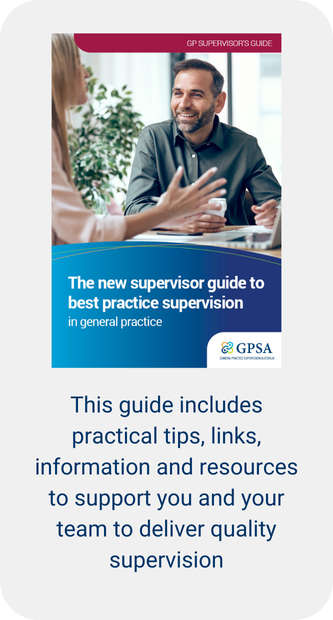
Patient Safety

Monitoring and maintaining patient safety is the most fundamental aspect of the GP supervisor’s role.


Clinical oversight

It is essential that the supervisor implement a model of clinical oversight that reflects the learner’s level of competence and ensures safe patient care. This requires early and ongoing assessment of performance, and a clear understanding of the nature and volume of patient encounters.

One of the key aspects to ensure patient safety it is important for the learner to be able to seek assistance from the supervisor about clinical care, either within or soon after the encounter. This can be facilitated by a clinical supervision plan.

Cultural safety

Another important element of safety is cultural safety, in particular for Aboriginal and/or Torres Strait Islander patients. Cultural safety has been defined as ‘overcoming the power imbalances of places, people and policies that occur between the majority non-Indigenous position and the minority Aboriginal and Torres Strait Islander person so that there is no assault, challenge or denial of the Aboriginal and Torres Strait Islander person’s identity, of who they are and what they need’ (Closing the Gap, 2025). Supervisors have a responsibility to ensure that their patients are receiving culturally safe care by all providers, including learners in the practice.


Date reviewed: 05 November 2025

Please note that while reasonable care is taken to provide accurate information at the time of creation, we frequently update content and links as needed. If you identify any inconsistencies or broken links, please let us know by email.

This website uses cookies. Read our privacy policy.
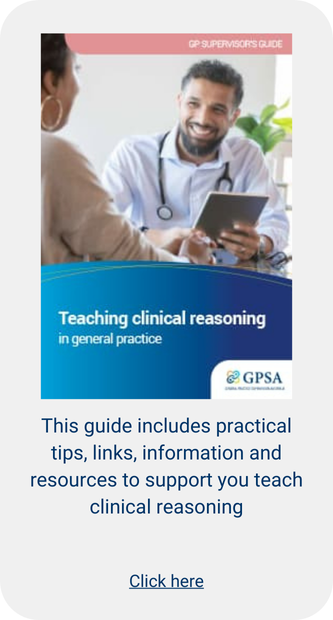
Clinical Reasoning

One of the most important aspects of the role of the GP supervisor is to help develop the learner’s clinical reasoning skills.

Clinical reasoning is the process of making sense of the clinical and contextual information regarding a patient’s presentation in order to determine the best plan of management. It requires the ability to gather and integrate various sources of information, to weigh evidence, manage uncertainty and to reflect upon the process used to reach the diagnosis and make a management plan.

Sound clinical reasoning is fundamental to safe and effective general practice. While development of clinical reasoning skills is partly based on accumulation of experience, it is also a skill that can be taught. GP supervisors therefore play a vital role in teaching their learners to reason effectively.

Webinar: ‘Gimme one reason’ – a guided tour of the hidden kingdom of clinical reasoning

At the end of this session, the supervisor will be able to:

  • discuss concepts of clinical reasoning and understand the process of ‘how doctors think’
  • describe common cognitive biases
  • use effective teaching and learning strategies and resources to develop clinical reasoning skills in their registrars

Date reviewed: 22 October 2025

Please note that while reasonable care is taken to provide accurate information at the time of creation, we frequently update content and links as needed. If you identify any inconsistencies or broken links, please let us know by email.

This website uses cookies. Read our privacy policy.
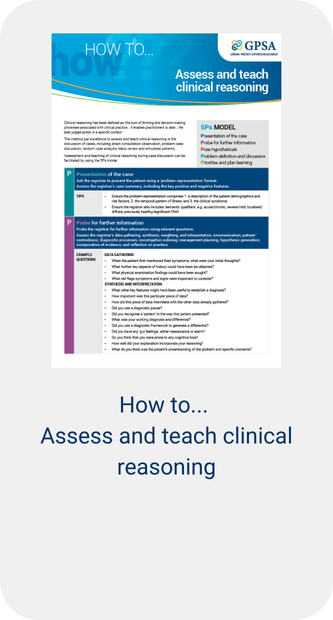
Australian Slang Dictionary

For convenience, you can read through this resource here, or use the pdf tools at the top of the document to download and / or print the file.

Date reviewed: 27 October 2025

Please note that while reasonable care is taken to provide accurate information at the time of creation, we frequently update content and links as needed. If you identify any inconsistencies or broken links, please let us know by email.

This website uses cookies. Read our privacy policy.

Information Sheet: Slang Terms in the Consulting Room

This information sheet explores common slang terms that might arise in consulting rooms, helping healthcare professionals better understand and communicate with patients. It serves as a resource to enhance clarity and rapport in clinical interactions.

For convenience, you can read through this resource here, or use the pdf tools at the top of the document to download and / or print the file. 

Date reviewed: 27 October 2025

Please note that while reasonable care is taken to provide accurate information at the time of creation, we frequently update content and links as needed. If you identify any inconsistencies or broken links, please let us know by email.

This website uses cookies. Read our privacy policy.

Worksheet: Body Slang Exercise

This page provides an engaging exercise worksheet on body slang to help medical professionals enhance their understanding of colloquial expressions. Perfect for GP registrars, it supports improved communication with patients through relatable language.

For convenience, you can read through this resource here, or use the pdf tools at the top of the document to download and / or print the file. 

Date reviewed: 27 October 2025

Please note that while reasonable care is taken to provide accurate information at the time of creation, we frequently update content and links as needed. If you identify any inconsistencies or broken links, please let us know by email.

This website uses cookies. Read our privacy policy.

Fact Sheet: Australian Health System and Medicare

For convenience, you can read through this resource here, or use the pdf tools at the top of the document to download and / or print the file. 

Date reviewed: 12 November 2025

Please note that while reasonable care is taken to provide accurate information at the time of creation, we frequently update content and links as needed. If you identify any inconsistencies or broken links, please let us know by email.

This website uses cookies. Read our privacy policy.

Fact Sheet: Organisation of the Australian Health Care System

For convenience, you can read through this resource here, or use the pdf tools at the top of the document to download and / or print the file. 

Date reviewed: 12 November 2025

Please note that while reasonable care is taken to provide accurate information at the time of creation, we frequently update content and links as needed. If you identify any inconsistencies or broken links, please let us know by email.

This website uses cookies. Read our privacy policy.

Article: Building a History Rather Than Taking One

This article explores the importance of “building” a patient’s history rather than merely “taking” one, emphasising a collaborative and patient-centered approach to consultations. It highlights how this methodology fosters trust and leads to better healthcare outcomes.

For convenience, you can read through this resource here, or use the pdf tools at the top of the document to download and / or print the file. 

Date reviewed: 21 October 2025

Please note that while reasonable care is taken to provide accurate information at the time of creation, we frequently update content and links as needed. If you identify any inconsistencies or broken links, please let us know by email.

This website uses cookies. Read our privacy policy.

Structure of the Consultation - Closing the Session

For convenience, you can read through this resource here, or use the pdf tools at the top of the document to download and / or print the file.

Date reviewed: 13 November 2025

Please note that while reasonable care is taken to provide accurate information at the time of creation, we frequently update content and links as needed. If you identify any inconsistencies or broken links, please let us know by email.

This website uses cookies. Read our privacy policy.

Developing Communication Skills - Excercises

For convenience, you can read through this resource here, or use the pdf tools at the top of the document to download and / or print the file. 

Date reviewed: 12 November 2025

Please note that while reasonable care is taken to provide accurate information at the time of creation, we frequently update content and links as needed. If you identify any inconsistencies or broken links, please let us know by email.

This website uses cookies. Read our privacy policy.