GPSA’s origins are in supporting supervisors of doctors in the Australian General Practice Training (AGPT) program, but our role has grown. Today, we support supervisors of all doctors learning in the GP clinical environment – from medical students and junior doctors to international medical graduates (IMGs), doctors in remediation, and vocational registrars across every training pathway.
It is well recognised that IMGs can face a range of challenges while learning in the general practice setting. GPSA recognises the critical role that GP supervisors play in supporting IMG registrars and other IMG GPs in training.
This page links to resources specific to supervising IMGs.
For teaching and learning specific to the consultation, please see the Consultation skills toolbox and the GPSA consultation skills teaching plans.
For general teaching and learning resources, see the Teaching and learning toolbox.
And please review the Supervision Resources page for a range of more generic resources.
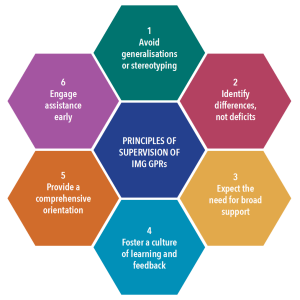
There are a number of broad principles that should guide the supervision of IMG learners. While these are appropriate to all registrars, they have particular importance for IMGs. These are elaborated upon in the Supervising the International Medical Graduate (IMG) GP Registrar Guide.

The key summary resource is the GPSA Supervising the International Medical Graduate (IMG) GP Registrar Guide.
Please also see the 2021 Webinar and FAQ.
General
Communication resources
Teaching and learning resources
Feedback resources
Vocational general practice training in Australia is based on the ‘apprenticeship model’, where registrars/RGs consult independently with patients, but practice under the supervision of accredited GP supervisors. GP supervisors therefore play an essential role in the development of registrars into confident and competent GPs.
This page links to resources specific to training GP registrars and rural generalists through AGPT.
Please review the Supervision Resources page for a range of more generic resources. And for College specific information, please visit RACGP or ACRRM.
One key resource that we would recommend reading as a useful overview is the The Guide to Best Practice Supervision of GP registrars and rural generalists.
For resources pertaining to the following topics, please visit the webpages
As a GP supervisor, you play a vital role in shaping the educational journey of medical students in Australia. Your guidance helps them develop essential clinical skills, professional attitudes, and an understanding of the fundamental place of general practice in the Australian healthcare system.
Resources
The key summary resource is the GPSA Best practice supervision of medical students in general practice guide. (under development).
For teaching and learning specific to the consultation, please see the Consultation skills toolbox and the GPSA consultation skills teaching plans.
For general teaching and learning resources, see the Teaching and learning toolbox.
And please review the Supervision Resources page for a range of more generic resources.
Prevocational training is the period of transition for junior doctors from the completion of medical school to commencement of specialty training. Prevocational training focuses on developing safe, competent, compassionate, high-quality patient care.
The new National Framework for Prevocational (PGY1 & PGY2) Medical Training supports prevocational training in Australia.
Prevocational doctors have traditionally completed terms in public hospitals but are increasingly being placed into general practices and community-based facilities. GP supervisors therefore play an essential role in the development of junior doctors into competent practitioners.
The key resource that we would recommend reading as a useful overview is the Best Practice Supervision of prevocational doctors (under development).
Please review the Supervision Resources page for a range of more generic resources.
Date reviewed: 11 February 2026